Fixed price vs cost-plus building contracts: how to choose
By Nathan Sherry · Updated 2026-07-23
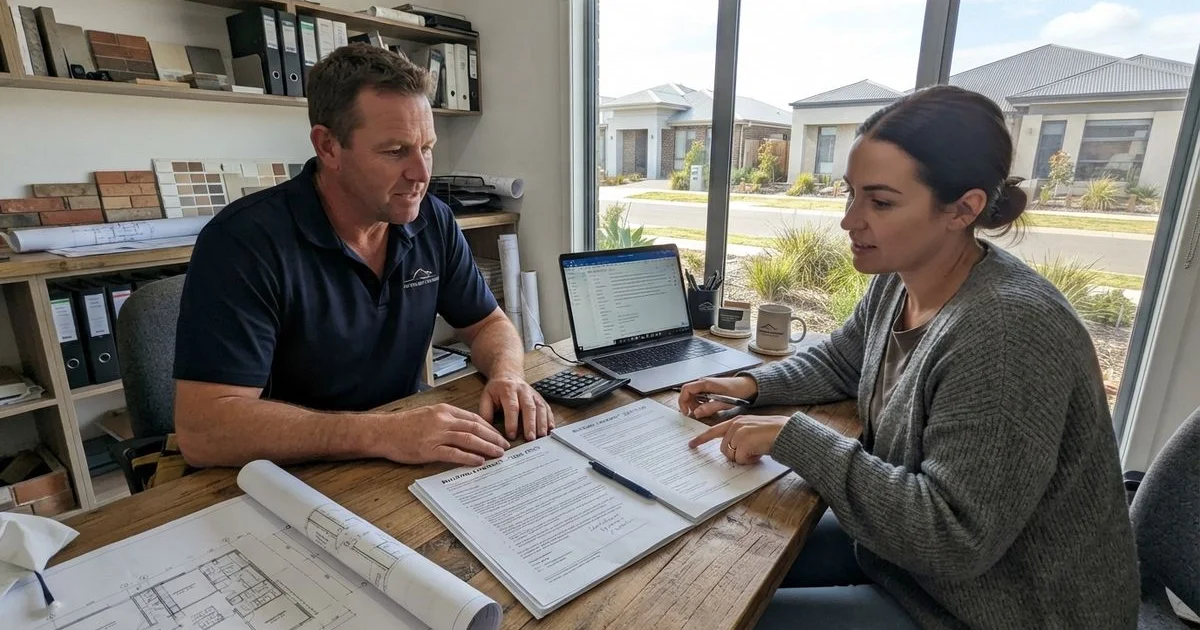
The contract type you sign shapes who carries the financial risk if something changes mid-build, and it is worth understanding before you compare quotes, not after. This guide explains what actually differs between a fixed price and a cost-plus building contract, so you can weigh the trade-off with your eyes open.
This is general information to help you compare contract structures, not legal or financial advice for your specific contract. Have any building contract reviewed by a solicitor or building consultant before you sign.
Fixed price, in plain terms
A fixed price building contract sets a single, agreed total for the whole project before work starts. The builder carries the risk if material costs rise or a stage runs into unexpected trouble, in exchange for pricing in a contingency margin up front. For the homeowner, the appeal is certainty: you know the number and it should not move, provided you do not change the scope.
The catch is what counts as “the scope.” Provisional sums (estimated allowances for items not yet finalised, like a kitchen benchtop or landscaping) and prime cost items work the same way in either contract type, and if the actual cost of those items exceeds the allowance, you pay the difference even under a fixed price contract.
Cost-plus, in plain terms
A cost-plus contract has you reimbursing the builder for the actual, verified cost of labour and materials, plus an agreed margin or fee on top. There is no single locked total. This suits projects where the scope is likely to evolve, a heritage renovation, a highly bespoke design, or a build where final selections have not been made yet, because it avoids the builder padding a fixed price to cover uncertainty they cannot price accurately.
The trade-off is that you carry more of the cost risk, and the final number depends heavily on how tightly the builder manages the job and how disciplined you are about locking in decisions early.

Side by side
| Fixed price | Cost-plus | |
|---|---|---|
| Who carries cost-overrun risk | Mostly the builder | Mostly the homeowner |
| Budget certainty | High, if scope does not change | Lower, tracks actual costs |
| Best suited to | Well-documented, finalised designs | Evolving or highly bespoke scopes |
| Homeowner effort required | Lower once signed | Higher, needs active budget tracking |
| Typical headline price | Often higher upfront | Can start lower, moves with costs |
What to check regardless of which you choose
Whichever structure you pick, confirm three things in writing before signing: how variations are priced and approved, how provisional sums and prime cost items are reconciled at the end of the job, and what reporting you receive on actual costs if you are on a cost-plus arrangement. Ask your builder for an example of a recent project’s final cost reconciliation so you can see how the numbers actually played out for someone else. Transparent pricing is one of the traits we weigh under our rubric when scoring builders on this directory, and it is worth checking a builder’s track record on this specifically before you sign either type of contract.
However you structure the contract, the way payments are staged through the build matters just as much; see our guide on protecting your deposit through progress payments for what a fair payment schedule looks like.
A hybrid middle ground
Some builders offer a structure that sits between the two: a fixed price for the base build, with named provisional sums for the items still being decided, kitchen benchtops, tiling, landscaping, and so on. This does not remove risk entirely, since those provisional items can still land above the allowance, but it narrows the uncertainty to a shorter, clearly listed set of line items rather than the whole project. If you are not fully settled on every finish but want more certainty than a pure cost-plus arrangement, ask whether your builder offers this option and how many items it typically leaves as allowances.
Which one is right for your project
If your design, finishes and selections are fully locked in before you sign, a fixed price contract gives you the certainty most owner-occupiers want. If you are still finalising design decisions, working on a heritage or highly irregular site, or you have a trusted builder relationship and want flexibility, cost-plus can be the more honest option, provided you are comfortable actively tracking the budget as the job goes. Neither structure is inherently better; the right one depends on how settled your scope actually is.
Common questions
- Which contract type is cheaper overall?
- Neither is reliably cheaper. A fixed price contract often has a higher headline number because the builder prices in risk and contingency. A cost-plus contract can come in lower or higher than expected, since you are exposed to the actual costs as they land.
- Can a fixed price contract still go up?
- Yes, if you make changes after signing, or if the contract includes provisional sums or prime cost items that turn out to cost more than allowed for. A fixed price only fixes the scope that was actually priced.
- Is cost-plus riskier for the homeowner?
- It shifts more of the cost risk to you, since you are covering actual costs plus a builder margin rather than a locked total. It can work well if you trust the builder and want flexibility, but it needs active budget tracking on your part.
- Can I negotiate the terms of either contract type?
- Yes. Both are negotiable, particularly around what counts as a variation, how provisional sums are handled, and what documentation you receive as costs are incurred. Read the draft closely before signing.